
Sri Chaitanya
Enter the OTP sent to your mobile
NTA Session 2 Scorecard Link ACTIVE @ jeemain.nta.nic.in Toppers List, Cutoff
Final Answer Keys for JEE (Main) 2026 Session II (B.E./B.Tech) are now available for download on jeemain.nta.nic.in
The National Testing Agency (NTA) is verifying reported issues. Candidates are advised not to pay for challenges until official notice on jeemain.nta.nic.in
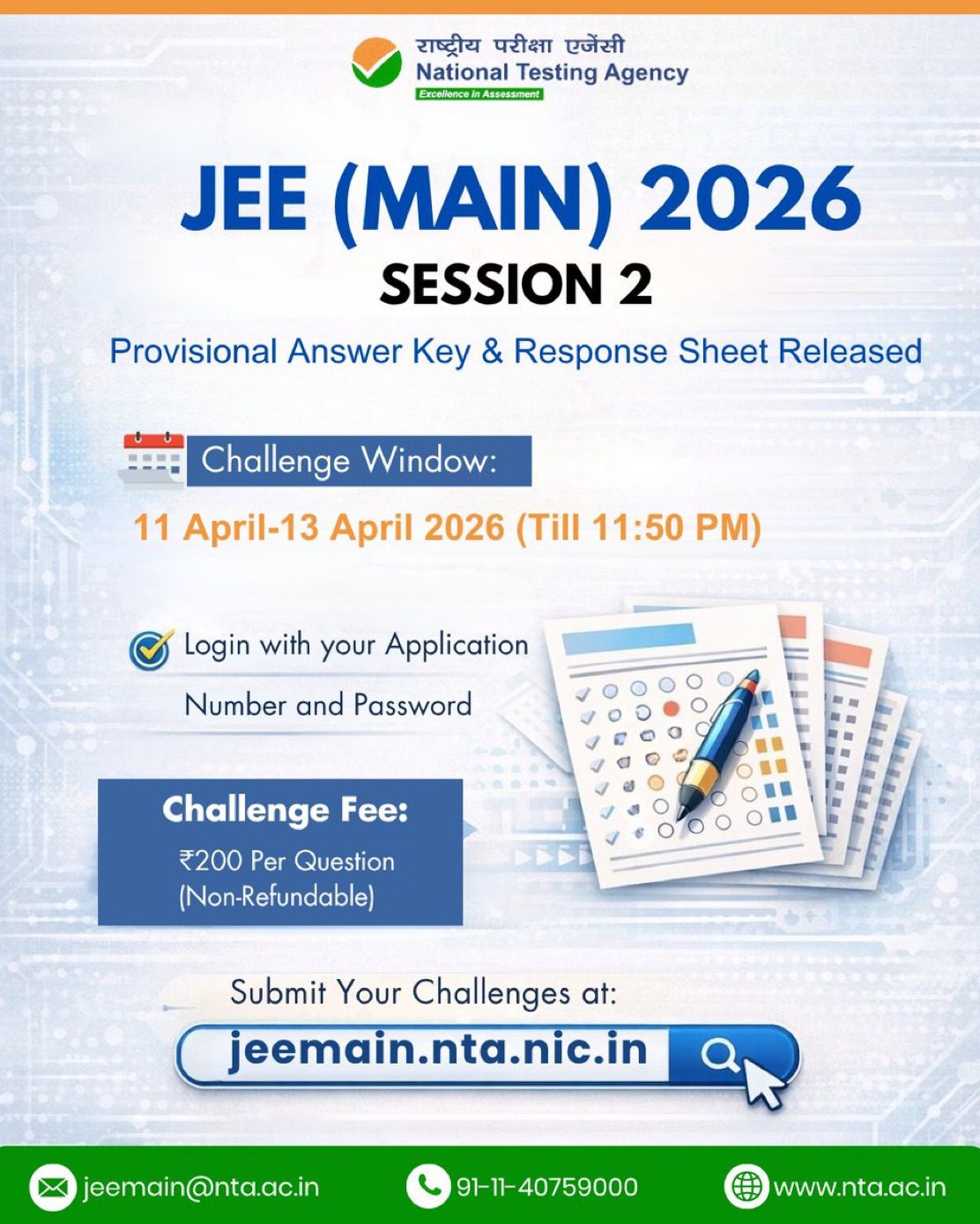
The challenge window is now open. Students can raise objections till April 13, 2026 (11:50 PM) jeemain.nta.nic.in — LIVE
JEE MAIN SESSION 2 , Provisonal Key & Answer Key Released on jeemain.nta.nic.in — LIVE
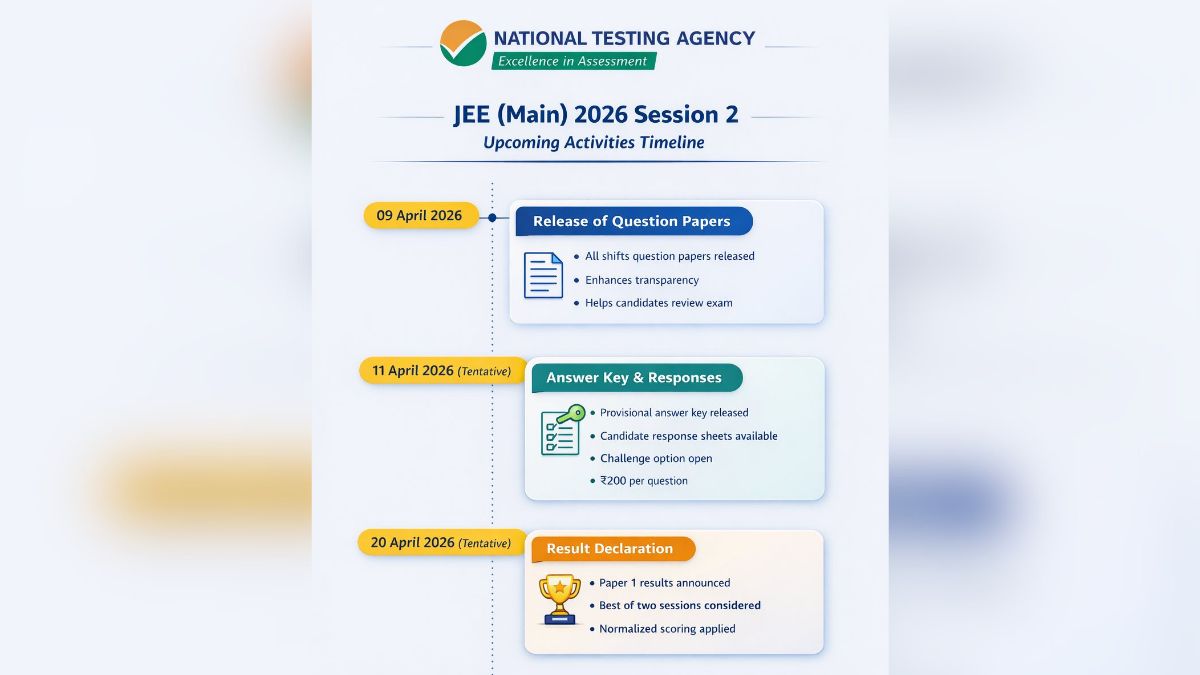
The National Testing Agency (NTA) will announce the JEE Mains Paper 1 results by April 20 (Tentative) 2026, on jeemain.nta.nic.in
The provisional answer keys and students’ response sheets for JEE Mains will be released on April 11. — LIVE
The NTA has released the JEE Mains Session 2 question papers on April 9 for all shifts at jeemain.nta.nic.in — LIVE
Released on March 29 (For April 2 and 4 exams) - OUT
Released on March 21, 2026 at jeemain.nta.nic.in - OUT
Paper 1 – April 2, 4, 5, 6, 8 Paper 2A & 2B – April 7, 2026 - CONFIRMED
Declared on February 16, 2026. 12 students scored 100 percentile. - OUT
Scheduled on May 17, 2026 by IIT Roorkee. Registration from April 23. - CONFIRMED
Increased to 323 cities in India + 15 cities outside India.
📥 Download the PDF to access the complete question paper with solutions.
| JEE Main Question Paper | Download Link |
|---|---|
| JEE MAIN 2nd April Shift 1 | Download PDF |
| JEE MAIN 2nd April Shift 2 | Download PDF |
| JEE MAIN 4th April Shift 1 | Download PDF |
| JEE MAIN 4th April Shift 2 | Download PDF |
| JEE MAIN 5th April Shift 1 | Download PDF |
| JEE MAIN 5th April Shift 2 | Download PDF |
| JEE MAIN 6th April Shift 1 | Download PDF |
| JEE MAIN 6th April Shift 2 | Download PDF |
| JEE MAIN 8th April Shift 2 | Download PDF |
| Particulars | Details |
|---|---|
| Exam Conducting Body | National Testing Agency (NTA) |
| Exam Name | Joint Entrance Examination (JEE) Main 2026 |
| Official Website | jeemain.nta.nic.in |
| Mode of Exam | Computer-Based Test (CBT); Drawing Test offline for B.Arch |
| Languages | 13 languages including English, Hindi, and 11 regional languages |
| Session 1 Exam Dates |
January 21–24, 28 (Paper 1) January 29 (Paper 2) Conducted |
| Session 1 Result | February 16, 2026 Declared |
| Session 2 Exam Dates |
April 2, 4, 5, 6, 8 (Paper 1) April 7 (Paper 2A & 2B) Upcoming |
| Session 2 City Slip | March 21, 2026 Released |
| Session 2 Admit Card | March 29, 2026 (For April 2 & 4 exams) Released |
| Session 2 Result | April 20, 2026 Expected |
| JEE Advanced 2026 | May 17, 2026 (IIT Roorkee) |
| JoSAA Counselling | June–July 2026 |
| Total Registered (Session 1) | 13,55,293 candidates |
| Exam Cities | 323 cities in India + 15 cities abroad |
The National Testing Agency (NTA) has officially revised the exam schedule for JEE Main 2026 Session 2. As per the latest update, the exam will now be conducted on April 2, 4, 5, 6, 7, and 8, 2026, instead of the earlier planned dates from April 2 to April 9.
Additionally, the city intimation slip for Session 2 was released on March 21, 2026. Candidates can download their city allotment details by visiting the official website jeemain.nta.nic.in and logging in using their application number and password.
| Event | Date | Status |
|---|---|---|
| Session 2 Registration Start | Last week of January 2026 | Closed |
| Session 2 Registration Last Date | February 25, 2026 | Closed |
| Form Correction Window | February 27–28, 2026 | Closed |
| City Intimation Slip Released | March 21, 2026 | Out |
| Session 2 Admit Card | Released on March 29 (For April 2 and 4 exams) | Out |
| Paper 1 (B.E./B.Tech) Exam Dates | April 2, 4, 5, 6, 8, 2026 | Upcoming |
| Paper 2A (B.Arch) & 2B (B.Planning) | April 7, 2026 | Upcoming |
| Provisional Answer Key | April 2026 | Tentative |
| Session 2 Result & Final AIR | April 20, 2026 | Tentative |
The JEE Main 2026 Session 2 exam will be held in two shifts daily — 9 AM to 12 Noon and 3 PM to 6 PM. Over 10 lakh candidates are expected to appear.
The final All India Rank (AIR) will be calculated based on the best score from both sessions, and the top 2.5 lakh candidates will qualify for JEE Advanced 2026, scheduled on May 17, 2026.
The city intimation slip only shows the exam city and date and is not valid for entry. Candidates must carry the official admit card to the exam centre.
For queries, contact the National Testing Agency (NTA) helpline: 011-40759000 (10 AM – 5 PM).
The National Testing Agency (NTA) announced the JEE Main 2026 Session 1 results on February 16, 2026. Candidates can download their scorecards from jeemain.nta.nic.in using their application number and password.
The result includes subject-wise percentile scores and the overall NTA percentile. The All India Rank (AIR) will be released only after the completion of Session 2 in April.
| Statistic | Figure |
|---|---|
| Total Registered Candidates (Paper 1) | 13,55,293 |
| Total Appeared Candidates (Paper 1) | 13,04,653 |
| Attendance Rate | 96.26% (Historic high) |
| Candidates with 100 Percentile | 12 (all male) |
| Top Female Scorer | Ashi Grewal, Haryana – 99.9969766 percentile |
| Results Withheld | 68 (unfair means / identity discrepancies) |
| Questions Dropped (Final Answer Key) | 9 questions across all 10 shifts |
| Exam Languages | 13 |
| Marks Range (Out of 300) | Expected Percentile | Estimated Rank Range |
|---|---|---|
| 235+ | 99.5+ | Top 500 |
| 200–234 | 99.0–99.5 | 501–3,000 |
| 160–199 | 97–98.9 | 3,001–10,000 |
| 140–160 | 96–98 | 10,001–20,000 |
| 120–140 | 94–96 | 20,001–40,000 |
| 100–120 | 90–94 | 40,001–80,000 |
| 70–99 | 83–90 | 80,001–1,50,000 |
| Below 70 | Below 83 | 1,50,000+ |
Note: Percentile varies shift-wise. Scores in a tough shift yield higher percentile at lower marks. NTA normalises scores across shifts.
| Event | Date | Status |
|---|---|---|
| Registration Start | October 31, 2025 | Done |
| Registration Last Date | November 27, 2025 | Done |
| Form Correction | December 1–2, 2025 | Done |
| City Intimation Slip | First week of January 2026 | Done |
| Session 1 Admit Card | January 17, 2026 | Done |
| Session 1 Exam – Paper 1 (B.E./B.Tech) | January 21, 22, 23, 24, 28, 2026 | Conducted |
| Session 1 Exam – Paper 2 (B.Arch/B.Plan) | January 29, 2026 | Conducted |
| Provisional Answer Key | February 4, 2026 | Done |
| Answer Key Challenge Window | February 4–6, 2026 | Done |
| Final Answer Key & Result (Paper 1) | February 16, 2026 | Done |
| Event | Date | Status |
|---|---|---|
| Session 2 Registration Start | Last week of January 2026 | Done |
| Session 2 Registration Last Date | February 25, 2026 | Done |
| Form Correction Window | February 27–28, 2026 | Done |
| City Intimation Slip Released | March 21, 2026 | Out |
| Session 2 Admit Card | Released on March 29, 2026 (For April 2 and 4 exams) | Out |
| Paper 1 – B.E./B.Tech Exam | April 2, 4, 5, 6, 8, 2026 | Upcoming |
| Paper 2A (B.Arch) & 2B (B.Planning) | April 7, 2026 | Upcoming |
| Provisional Answer Key | April 2026 | Tentative |
| Session 2 Result + Final AIR | April 20, 2026 | Tentative |
| JEE Advanced 2026 Registration | April 23, 2026 | Upcoming |
| JEE Advanced 2026 Exam | May 17, 2026 | Upcoming |
| JoSAA Counselling | June–July 2026 | Upcoming |
JEE Main 2026 is a national-level engineering entrance exam conducted by the National Testing Agency (NTA). It is the gateway for admission to B.E./B.Tech, B.Arch, and B.Planning courses in NITs, IIITs, and GFTIs across India, and also serves as the qualifying exam for JEE Advanced 2026.
In 2026, over 13.5 lakh candidates registered for Session 1 alone. The exam is conducted in CBT mode, testing Class 11 & 12 concepts in Physics, Chemistry, and Mathematics, while the B.Arch Drawing test is held offline.
Before applying for JEE Main 2026, candidates must ensure they meet the eligibility criteria, including academic qualifications, nationality, and age. Applicable category-wise relaxations are also provided as per guidelines.
Candidates must have passed or be appearing in Class 12 (or equivalent) in 2024, 2025, or 2026, with Physics and Mathematics as compulsory subjects along with one of Chemistry, Biology, Biotechnology, or a technical vocational subject.
Eligible candidates also include:
| Category | Minimum Marks in Class 12 |
|---|---|
| General (UR) | 75% aggregate (or top 20 percentile in board) |
| SC / ST | 65% |
| OBC-NCL | 65% |
| PwD – General | 65% |
| PwD – SC/ST/OBC | 65% |
Note: The 75% criteria applies only for admission to NITs, IIITs, IITs, and GFTIs — not for appearing in JEE Main.
JEE Main 2026 is conducted in Computer-Based Test (CBT) mode and consists of three papers designed for different courses. A key update for 2026 is the introduction of an on-screen calculator, which will be available to all candidates during the exam. This new feature is expected to improve accuracy and help students perform calculations more efficiently.
| Subject | MCQ (–1 for wrong) | Numerical (No negative marking) | Total Questions | Total Marks |
|---|---|---|---|---|
| Physics | 20 | 5 (attempt any 5 of 10) | 25 (attempt) | 100 |
| Chemistry | 20 | 5 (attempt any 5 of 10) | 25 (attempt) | 100 |
| Mathematics | 20 | 5 (attempt any 5 of 10) | 25 (attempt) | 100 |
| Total | 60 | 15 | 75 | 300 |
| Section | Questions | Marks | Mode |
|---|---|---|---|
| Mathematics (Part I) | 25 | 100 | CBT |
| General Aptitude (Part II) | 50 | 200 | CBT |
| Drawing Test (Part III) | 2 | 100 | Offline (A4 sheet) |
| Total | 77 | 400 | — |
| Section | Questions | Marks | Mode |
|---|---|---|---|
| Mathematics (Part I) | 25 | 100 | CBT |
| General Aptitude (Part II) | 50 | 200 | CBT |
| Planning-Based Questions (Part III) | 25 | 100 | CBT |
| Total | 100 | 400 | — |
The JEE Main 2026 application form is available only in online mode at jeemain.nta.nic.in, and the National Testing Agency (NTA) does not accept offline applications under any circumstances. The Session 1 registration was conducted from October 31 to November 27, 2025, while the Session 2 registration process was completed on February 25, 2026. Candidates were required to complete the entire application process within these timelines.
The JEE Main 2026 Session 2 admit card was released on March 29, 2026 for exams scheduled on April 2 and 4, while admit cards for the remaining dates are released 3–4 days before the exam. Candidates can download it from jeemain.nta.nic.in using their application number and password.
The admit card is the only valid entry document for the exam hall. The city intimation slip (released on March 21) cannot be used as a substitute. Candidates must carry a printed admit card along with a valid photo ID on the exam day for verification.
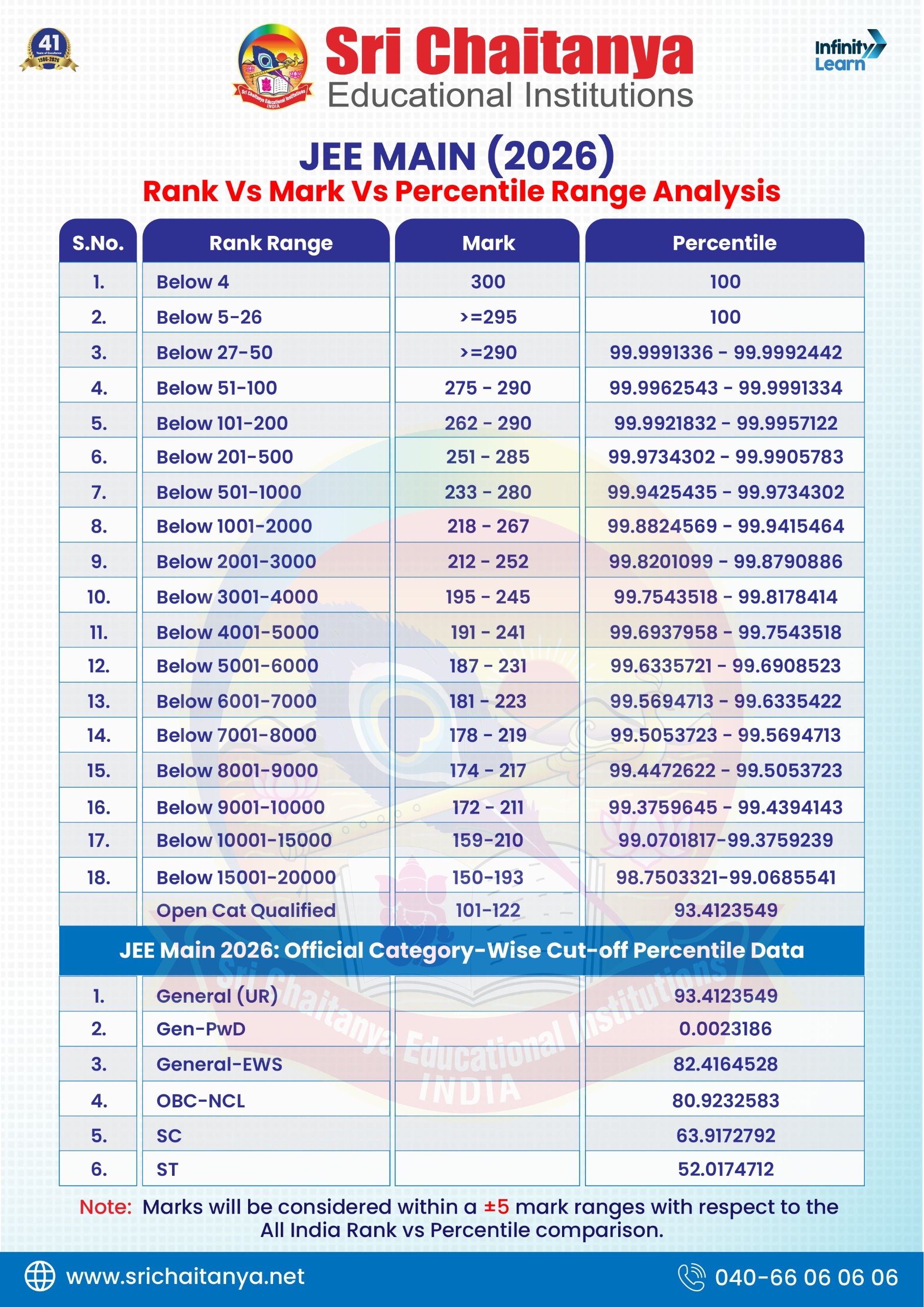
The JEE Main 2026 cutoff is the minimum percentile required to qualify for JEE Advanced 2026. The official cutoff will be announced by the National Testing Agency (NTA) along with the Session 2 results on April 20, 2026. Based on Session 1 trends and expert analysis, the following are the expected cutoff ranges for different categories.
| Category | Expected Percentile 2026 | 2025 Actual Cutoff | 2024 Actual Cutoff |
|---|---|---|---|
| General (UR / CRL) | 93.3 – 95.0 | 93.1023262 | 93.2446723 |
| Gen-EWS | 80.5 – 82.5 | 81.3266412 | 75.6229025 |
| OBC-NCL | 79.0 – 82.0 | 79.6757881 | 73.6114227 |
| SC | 61.0 – 64.0 | 60.0991466 | 51.9776027 |
| ST | 47.5 – 51.0 | 47.1511367 | 37.2348772 |
| UR-PwD | 0.0011 – 0.5 | 0.0031029 | 0.0013527 |
| Year | General Category Cutoff (Percentile) |
|---|---|
| 2021 | 87.8992241 |
| 2022 | 88.4121383 |
| 2023 | 90.7788642 |
| 2024 | 93.2446723 |
| 2025 | 93.1023262 |
| 2026 (Expected) | 93.3 – 95.0 |
Note: Only the top 2.5 lakh JEE Main qualifiers are eligible for JEE Advanced 2026. Admission cutoffs for NITs, IIITs, and GFTIs are published separately after JoSAA counselling.
The JEE Main 2026 syllabus is based on the NCERT curriculum of Classes 11 and 12, covering Physics, Chemistry, and Mathematics. The syllabus remains largely unchanged from the previous year, ensuring consistency for students. However, focusing on high-weightage topics is important for better scoring, and some key topics are listed below.
JEE Advanced 2026 will be conducted by IIT Roorkee on May 17, 2026 (Sunday). It serves as the gateway for admission into all 23 Indian Institutes of Technology (IITs) across India. The registration process for eligible candidates is scheduled to begin on April 23, 2026, shortly after the JEE Main results.
| Particulars | Details |
|---|---|
| Conducting Body | IIT Roorkee |
| Exam Date | May 17, 2026 (Sunday) |
| Registration Start | April 23, 2026 |
| Eligibility | Top 2.5 lakh JEE Main 2026 qualifiers |
| Number of Papers | 2 (Paper 1 + Paper 2, both in CBT mode) |
| Admit Card | May 11–17, 2026 at jeeadv.ac.in |
| Maximum Attempts | 2 (in consecutive years) |
| Official Website | jeeadv.ac.in |
To qualify for JEE Advanced 2026, candidates must meet specific eligibility criteria. They should be among the top 2.5 lakh rank holders in JEE Main, have passed Class 12 in 2025 or 2026, and must be within two consecutive attempts. Additionally, candidates should not have previously accepted admission to any IIT seat, as per the official eligibility rules.
The Joint Seat Allocation Authority (JoSAA) conducts the centralised counselling and seat allotment for admissions to NITs, IIITs, GFTIs, and IITs. JoSAA 2026 is expected to begin in June 2026, after the declaration of JEE Advanced results. The process includes six main rounds of seat allotment, followed by CSAB special rounds to fill any remaining vacant seats.
| Institute | Branch | Opening Rank | Closing Rank |
|---|---|---|---|
| NIT Trichy | Computer Science & Engg. | 1,400 | 5,300 |
| IIIT Hyderabad | Computer Science & Engg. | 150 | 1,000 |
| NIT Warangal | Electronics & Comm. Engg. | 2,400 | 6,700 |
| NIT Surathkal | Mechanical Engg. | 5,200 | 11,000 |
| NIT Calicut | Computer Science & Engg. | 2,100 | 7,500 |
IITs admit students exclusively through JEE Advanced 2026. The above data is based on JoSAA 2025 Round 1 and is provided for reference. It will be updated for 2026 once the counselling process officially begins and new data is released.
| Rank | IIT | Location | Known For |
|---|---|---|---|
| 1 | IIT Madras | Chennai, Tamil Nadu | Research, Entrepreneurship, CSE |
| 2 | IIT Bombay | Mumbai, Maharashtra | Placements, Global Recognition, Finance |
| 3 | IIT Delhi | New Delhi | Engineering, Management, Policy Research |
| 4 | IIT Kanpur | Kanpur, UP | Core Engineering, Computer Science, Aeronautics |
| 5 | IIT Kharagpur | Kharagpur, West Bengal | Oldest IIT, Law, Architecture |
| 6 | IIT Roorkee | Roorkee, Uttarakhand | Civil Engineering, JEE Advanced 2026 Organiser |
| 7 | IIT Guwahati | Guwahati, Assam | Modern Infrastructure, NE India Hub |
| 8 | IIT Hyderabad | Hyderabad, Telangana | AI Research, Tech Innovation |
| 9 | IIT (BHU) Varanasi | Varanasi, UP | Tradition + Modern Education Mix |
| 10 | IIT Indore | Indore, MP | Emerging Research Hub, IIoT |
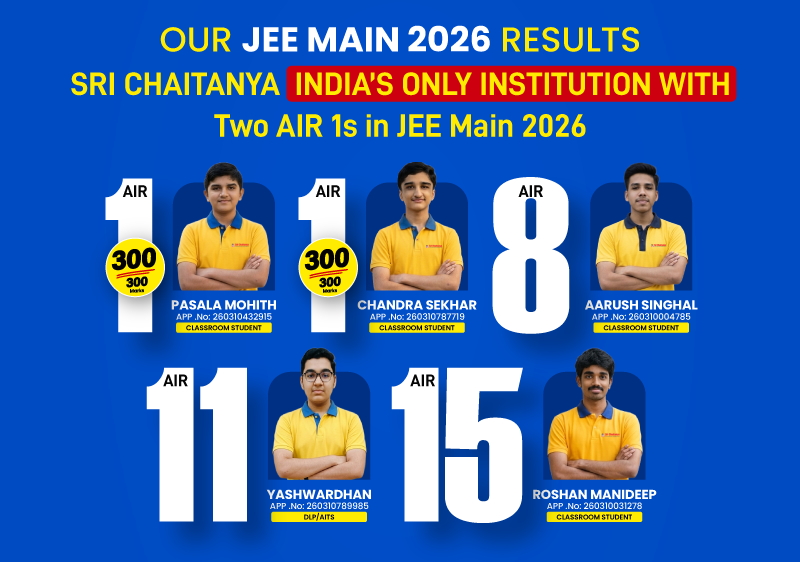
With over 41 years of academic excellence, Sri Chaitanya has empowered more than one million students to achieve their highest aspirations. Our integrated approach combines strong fundamentals, disciplined preparation, and expert mentorship to deliver consistent top ranks.
From IITs and NITs to leading medical institutions, we transform ambition into accomplishment and potential into performance.
